Engineering project
ContextForge
Agentic RAG backend for engineering knowledge, code, logs, tool calling, and grounded answers.
RAG LangChain LangGraph FastAPI PostgreSQL/pgvector Agent Systems
Problem
Engineering teams have knowledge scattered across docs, repositories, logs, issues, and operational tools. A useful assistant needs retrieval, citations, workflow control, and evaluation rather than a simple prompt wrapper.
Current status
Design skeleton with implementation milestones.
What I built
- Outlined an ingestion pipeline for docs, code, and logs with chunking and embedding boundaries.
- Designed retrieval and reranking flow that returns citations for grounded answers.
- Prepared a LangGraph-style agent skeleton for tool calls, query planning, and answer synthesis.
Architecture / system design
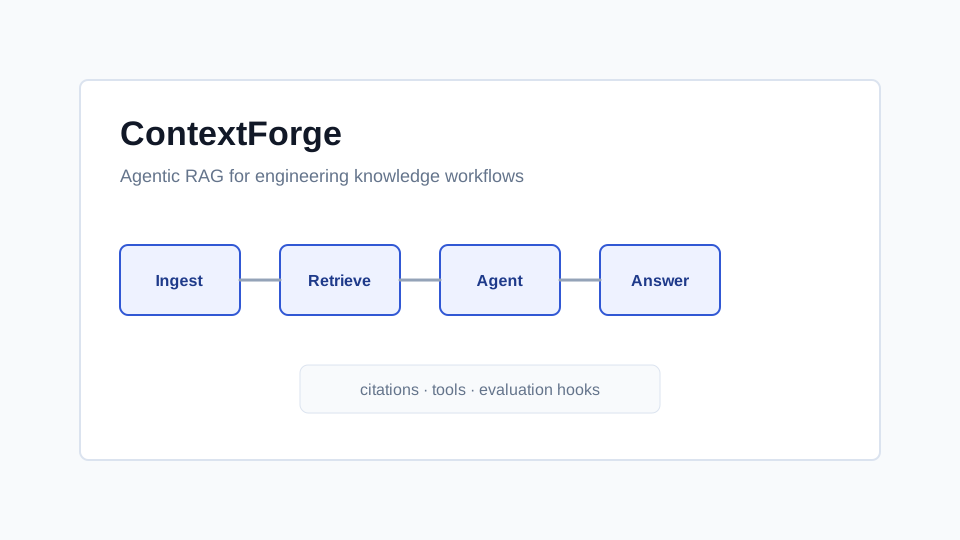
- 01
Docs / Code / Logs
- 02
Ingestion
- 03
Chunking / Embeddings
- 04
Retrieval / Reranking
- 05
LangGraph-style Agent Workflow
- 06
Tool Calls
- 07
Grounded Answer with Citations
Technical highlights
- Separates retrieval, planning, tool execution, and final response synthesis.
- Treats citations and evaluation hooks as core design constraints.
- Keeps the backend static-deploy independent by avoiding hosted services in the portfolio version.
Future work
- Add a small reproducible corpus for evaluation examples.
- Implement answer quality tests for groundedness and source coverage.
- Document failure modes around stale context and ambiguous queries.
Tech stack
FastAPI LangChain LangGraph PostgreSQL pgvector Pydantic pytest
Demo / screenshots
A small engineering knowledge demo corpus will be added before publishing the repository.
Resume bullet draft
- Designed an agentic RAG backend for engineering knowledge workflows with document/code ingestion, retrieval, tool calling, and citation-grounded answers.
- Prepared evaluation hooks for answer groundedness, retrieval quality, and workflow failure analysis.